



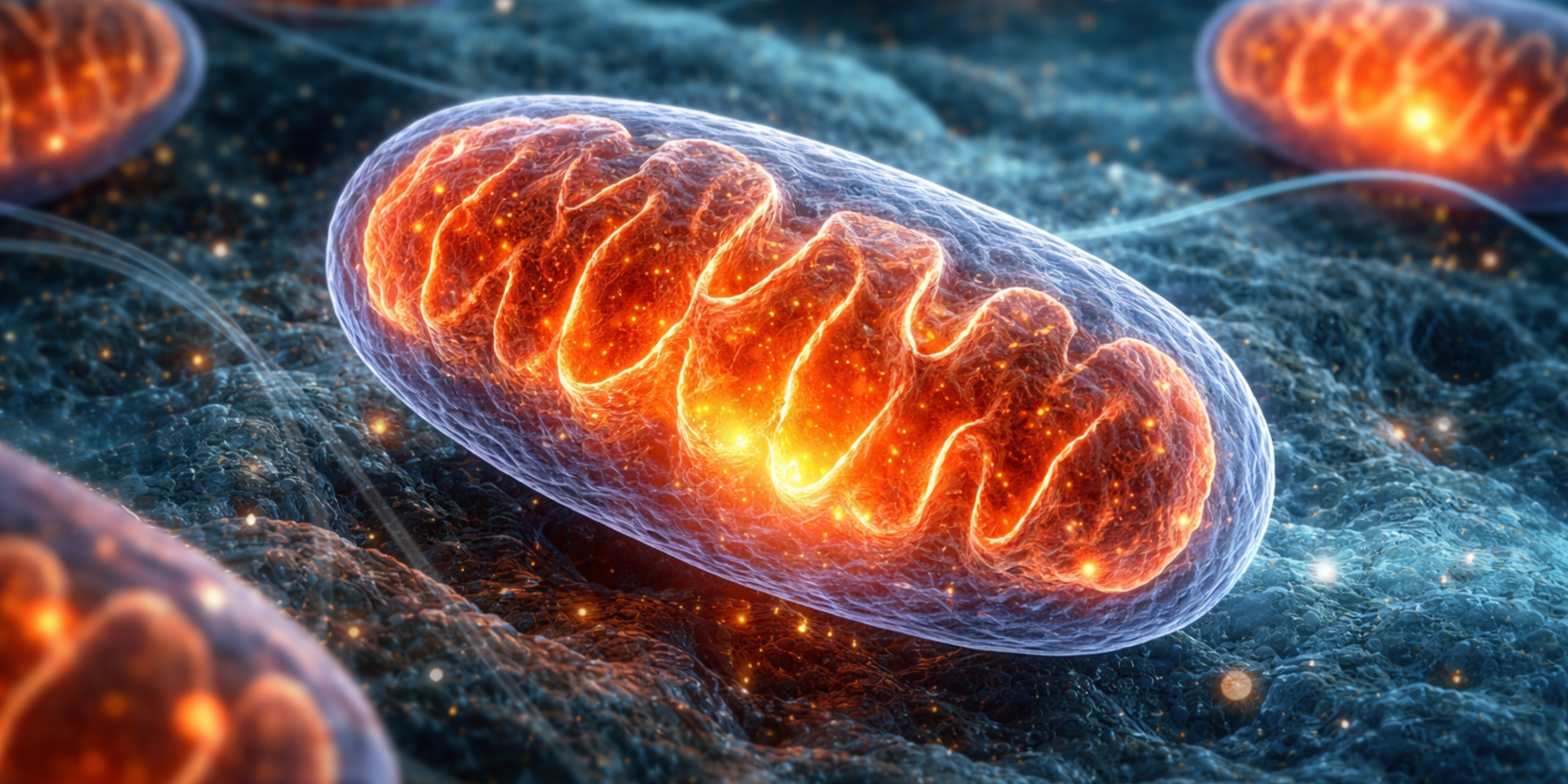
Calling mitochondria the "powerhouse of the cell" is a bit like calling your brain a calculator. It's not wrong. It's just incomplete.
Yes, mitochondria make energy. That's the line most of us learned in school and never revisited. But in the last two decades, researchers have quietly rewritten what these organelles are and what they're responsible for. They make energy, yes, but they also decide which cells live and which die, regulate inflammation, kick off hormone production, and coordinate how your body responds to stress. Focus, recovery, skin, sleep, mood, how fast you age, almost every part of how you feel on any given day runs through them.
The energy part is the easy part. When you eat something, your body breaks it down into fuel, feeds it into your mitochondria, and they produce ATP, adenosine triphosphate, the molecule your cells actually spend to do things. Muscle contraction costs ATP. Thinking costs ATP. Repairing a torn tendon, building a new skin cell, clearing a virus from your bloodstream, all ATP. An adult turns over roughly their own bodyweight in ATP every single day, cycling through around 50 kilograms of the stuff[1]. You only carry a few grams at any given moment; each molecule is recharged and spent again thousands of times. You recycle it that fast because you use it that fast.
So yes, mitochondria make energy. What most explanations skip is that the energy is almost beside the point. The interesting question is what they do with it, and what they do alongside it.

They aren't really part of you (sort of)
Here's something that still surprises me: mitochondria used to be bacteria.
Roughly 1.5 to 2 billion years ago, a larger cell swallowed a smaller energy-producing microbe and, instead of digesting it, struck a deal. The smaller cell got shelter. The larger cell got a massive upgrade in energy capacity. That single event, endosymbiosis, is generally credited with making complex life possible[2]. The evidence is still sitting inside your cells. Mitochondria have their own DNA, separate from the DNA in your cell's nucleus. They replicate on their own schedule. They have a double membrane, a leftover of being engulfed [3].
In a real sense, you're a partnership. There are two systems in there, and keeping them in sync matters.
The job description nobody told you about
Mitochondria aren't the battery. They're the operations team.
When a cell is under stress, damaged, infected, running low on nutrients, mitochondria are the ones that read the signal and decide what happens next. Repair? Recycle the damaged components? Trigger the cell to quietly destroy itself before it becomes a problem? That last one is called apoptosis, and it's one of the most important processes in your body. Cells that should die but don't become cancer. Cells that die when they shouldn't become neurodegeneration. Mitochondria sit at the switch: they release a protein called cytochrome c that kicks off the entire self-destruct sequence [4].
They buffer and release calcium, which is how cells communicate internally. They regulate inflammation, when damaged, they leak fragments that the immune system reads as a threat signal, which is part of why chronic low-grade inflammation (the kind linked to everything from cardiovascular disease to depression) so often traces back to mitochondrial dysfunction. The first step of steroid hormone synthesis, cholesterol to pregnenolone, happens inside them, meaning your cortisol, oestrogen, and testosterone production all start here [5]. Even the way your body generates heat in cold weather runs through a specialised class of mitochondria in brown fat, which burns fuel purely to keep you warm rather than to make ATP.
Energy is one thing they produce. Judgement is the other.
Why the count per cell matters
A single cell can contain several thousand mitochondria, and the number tells you something about what that cell does.
Mature red blood cells have none. They're essentially delivery trucks and don't need much internal machinery. Liver cells carry a thousand to two thousand, filling roughly a fifth of the cell's volume. Cardiac muscle cells, which never get to rest, contain around 5,000 each, and mitochondria occupy about a third of a heart cell's total volume. Neurons, by some estimates, can hold up to two million in the most energetically demanding cases [6,7]. The pattern is simple: the more metabolically demanding the job, the more mitochondria the cell dedicates to it.
This is why fatigue and brain fog so often travel together. The brain is about 2% of your bodyweight and burns roughly 20% of your energy [8]. When mitochondrial output drops system-wide, the organs with the highest energy demand feel it first. Thinking gets sluggish before your arms do.
It's also why aerobic exercise works. One of the things training does, maybe the most important thing, is stimulate your cells to build more mitochondria. A fit person doesn't just have stronger muscles. They have more engines inside each muscle cell. Same body, more power output, more resilience under load.

The slow, quiet slide
Here's the part of the story worth paying attention to, because it's the part that's happening to you right now.
Mitochondrial efficiency declines with age. In a study of 146 healthy adults aged 18 to 89, researchers at the Mayo Clinic found that skeletal muscle mitochondrial ATP production drops by roughly 8% per decade across adulthood [9]. That's a measurable, mechanical slowdown. Fewer mitochondria, and the ones you still have running less cleanly. The damage accumulates quietly, you don't notice the shift at 32 or 38 because there's no symptom that announces itself. You just start, at some point, to feel like a version of yourself that has a lower ceiling.
This is the part of ageing most people don't have language for. It isn't that you've suddenly got old; it's that the system you've been running on has lost some of its capacity, and the gap between what you used to do without thinking and what now takes real effort has widened. Energy doesn't rebound the way it used to. Recovery after a hard session or a bad night's sleep takes longer. Skin takes longer to bounce back. Cognitive work has a shorter runway before you're done for the day. Sleep itself can stop feeling restorative even when the hours look right on paper.
None of this is inevitable in the way we've been taught. Mitochondria respond to inputs. They multiply in response to aerobic exercise. They're damaged by chronic stress, erratic sleep, and constant bright light at night. They rely on specific nutrients, B vitamins, magnesium, CoQ10, NAD precursors, to run the reactions that keep them functional. Most of us are running on depleted reserves of at least some of these, not because we're doing anything wrong, but because modern life quietly outpaces what food and sleep alone can restore.
That's the thread worth pulling on. Not the promise of reversing age, which isn't a real thing anyone should sell you. But the more practical observation that mitochondrial health responds to how you live, and that the decline curve is less fixed than it looks.
What this actually changes
If you only remember one thing from this, make it this: how you feel today is largely a mitochondrial story. The energy, the clarity, the resilience, the skin, the recovery, these aren't separate problems with separate solutions. They're downstream of the same system.
That reframe changes what's worth paying attention to. Sleep matters because mitochondria do much of their repair work at night. Exercise matters because it's one of the few things that reliably builds new ones. Morning light matters because mitochondria operate on a circadian rhythm, and the broader body clock that governs them is set by your first daylight exposure. What you put in your body matters because they need specific raw materials to run.
You don't need to optimise everything. You just need to stop ignoring the system that everything runs on. Everything we make at Mitovitality is built around that single idea, that if you want to feel like yourself, you start with the cells that decide whether you can.
Supporting References:
[1] Voet, D. & Voet, J.G. (2011). Fundamentals of Biochemistry: Life at the Molecular Level, 5th ed. Wiley.
[2] Archibald, J.M. (2015). Endosymbiosis and eukaryotic cell evolution. Current Biology, 25(19), R911–R921.
[3] Roger, A.J., Muñoz-Gómez, S.A., & Kamikawa, R. (2017). The origin and diversification of mitochondria. Current Biology, 27(21), R1177–R1192.
[4] Wang, C. & Youle, R.J. (2009). The role of mitochondria in apoptosis. Annual Review of Genetics, 43, 95–118.
[5] Miller, W.L. (2013). Steroid hormone synthesis in mitochondria. Molecular and Cellular Endocrinology, 379(1–2), 62–73.
[6] Alberts, B. et al. (2014). Molecular Biology of the Cell, 6th ed. Garland Science — mitochondrial counts and volume fractions per cell type. Cardiac mitochondrial volume fraction: Schaper, J. et al. (1985), Circulation Research, 56(3), 377–391.
[7] "Could Mitochondria Be the Key to a Healthy Brain?" BrainFacts.org (Society for Neuroscience, 2021), citing estimates from researchers at the US National Institute of Neurological Disorders and Stroke. Note: primary neuroscience literature typically reports hundreds to thousands of mitochondria per neuron; the "up to 2 million" figure represents an upper bound in the most energetically demanding cells.
[8] Raichle, M.E. & Gusnard, D.A. (2002). Appraising the brain's energy budget. PNAS, 99(16), 10237–10239.
[9] Short, K.R. et al. (2005). Decline in skeletal muscle mitochondrial function with aging in humans. PNAS, 102(15), 5618–5623.


